Small Business
4
Answers
Founder of American food companies.
1) Pay too much
2) Do not ask for terms
3) Do not look for alternative suppliers/products
4) Vague specifications
5) Pay too slow
Answered 5 months ago
Strategic Market Understanding Expert
Across the world, many SMEs make similar mistakes while managing procurement, mainly because purchasing is treated as a routine operational task rather than a strategic function. One of the most common errors is **over-reliance on a small number of suppliers**, which exposes businesses to serious risks during global disruptions such as pandemics, wars, logistics bottlenecks, or raw-material shortages. SMEs also frequently **focus only on the lowest price**, ignoring factors like supplier reliability, quality consistency, delivery timelines, and after-sales support; this often results in higher long-term costs due to defects, delays, or production stoppages. Another widespread mistake is **poor demand forecasting**, where companies buy either too much (leading to excess inventory, storage costs, and cash flow strain) or too little (causing missed orders and unhappy customers). Many SMEs still rely on **manual procurement processes**, spreadsheets, or informal communication, which increases errors, reduces transparency, and makes it difficult to track supplier performance or spending patterns.
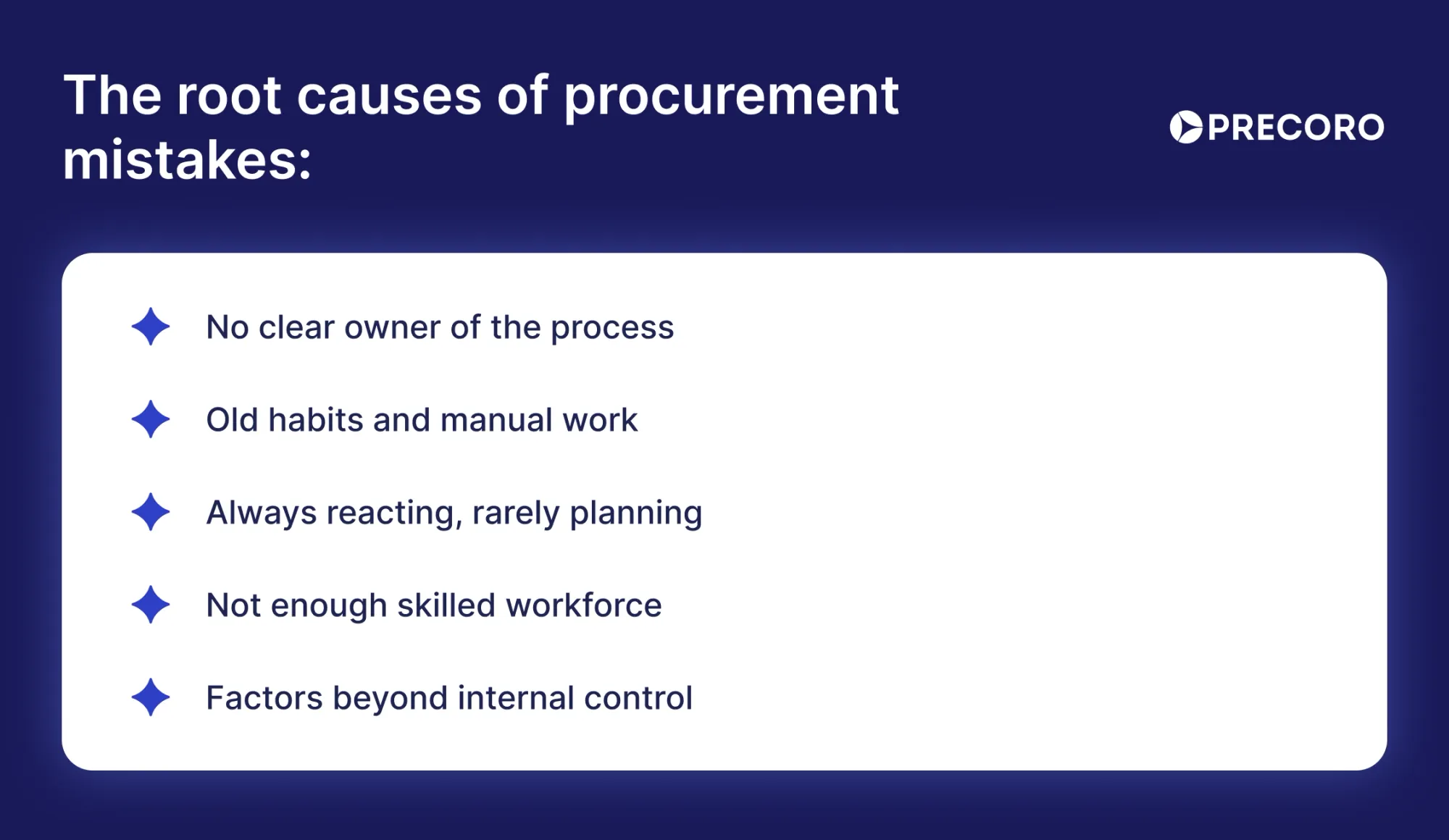
Additionally, SMEs around the world often lack **formal supplier evaluation and contract management systems**, leading to unclear terms, inconsistent pricing, and weak enforcement of delivery or quality standards. **Limited use of data and technology** is another global issue; without procurement analytics, SMEs struggle to negotiate better rates, identify cost leakages, or plan strategically. Many businesses also fail to **align procurement with overall business strategy**, purchasing reactively instead of supporting growth plans, market expansion, or sustainability goals. Finally, inadequate attention to **compliance and ethical sourcing**—such as environmental standards, labor practices, or local regulations—can create legal risks and damage brand reputation, especially when dealing with international suppliers. Globally, SMEs that overcome these mistakes by diversifying suppliers, adopting digital tools, planning demand carefully, and treating procurement as a strategic function tend to be more resilient, cost-efficient, and competitive in both local and international markets.
Answered 5 months ago
Let’s win together. Bid to finish. AI, EPC/PMC
1- My career started with SME
https://www.linkedin.com/in/rkme/
I was a Procurement Assistant manager with Obeetee
The common mistake is not getting Quality and Pre Audited material.
2- They just take degree not the skills whatever i have been through
3- If you do not have any source or are not in networking with pre defined or experienced people in business than you may also not get what your procurement was meant for
A mentor is must for a LONG time say 5-8 years minimum or a long term employee who can serve 8 years or more in the business those who can deal with the business not the procurement is must
Answered 5 months ago
Certified Power Platform CRM and ERP Consultant
I've worked with many SMEs on ERP and operations implementations, and procurement is consistently one of the areas where businesses leave the most money on the table. Here are the most common and costly mistakes I've seen:
1. No Formal Supplier Evaluation Process
Most SMEs pick suppliers based on whoever they found first or a personal referral. Without a structured evaluation (pricing, lead times, quality track record, payment terms), you end up locked into suboptimal relationships.
Fix: Build a simple supplier scorecard — even in Excel — and review it annually. Compare at least 3 quotes for any recurring purchase above a threshold.
2. Reactive Purchasing Instead of Planned Procurement
SMEs often buy when they're running out rather than based on demand forecasts. This leads to:
- Rush orders at premium prices
- Stockouts that disrupt operations
- Over-purchasing when panic sets in
Fix: Implement reorder points in your inventory system or ERP. Even basic tools like Zoho Inventory, DEAR, or QuickBooks with inventory modules can automate this.
3. No Purchase Order (PO) Process
Many SMEs operate without POs — verbal agreements or emails become the approval trail. This creates:
- Unauthorized spend
- Invoice disputes with suppliers
- No budget visibility
Fix: Introduce a simple PO workflow. Even a Google Form or a lightweight procurement tool like Precoro or Tradogram is better than nothing. If you're on Business Central or Dynamics 365, the PO workflow is built in.
4. Single-Sourcing Critical Items
Relying on one supplier for critical inputs is a significant business risk. Any disruption — supplier insolvency, shipping delays, capacity issues — can stop your operations.
Fix: Identify your top 10 most critical purchased items and ensure you have at least one qualified backup supplier for each.
5. Ignoring Total Cost of Ownership (TCO)
SMEs often choose the cheapest price without accounting for:
- Shipping and import costs
- Quality defect rates and rework costs
- Payment terms (net 60 vs. net 30 impacts cash flow)
- Minimum order quantities that force over-stocking
Fix: Build a simple TCO model for major purchases. The cheapest unit price is rarely the best value.
6. No Spend Analytics or Category Management
Without visibility into what you're spending and with whom, you can't negotiate effectively or identify consolidation opportunities.
Fix: Run a basic spend analysis quarterly — categorize your purchases by supplier and category, identify your top 20 suppliers by spend, and review whether contracts are in place.
7. Manual Processes That Don't Scale
Spreadsheet-based procurement works at small scale but breaks down quickly. As volume grows, approvals slip, invoices get lost, and compliance becomes a nightmare.
Fix: Invest early in a procurement module within your ERP (Business Central, SAP Business One, or Odoo all have strong SME procurement functionality) or a standalone tool that integrates with your accounting system.
Happy to discuss which of these applies most to your situation and what the right tooling looks like. Feel free to connect.
Answered 19 days ago